If your Google Ads account counts a form fill as its main conversion, two changes Google made in 2026 raised the cost of that setting. One handed more of your targeting to Google's model. The other changed the pipe that carries your sales data back to it.
Change one: AI Max took over broad match and auto-created assets
Starting in September 2026, Google began automatically upgrading Search campaigns that used the campaign-level broad match setting or automatically created assets to AI Max for Search. Dynamic Search Ads follow later: Google's announcement puts their automatic migration in February 2027. (TechWyse's migration summary tracks the dates.)
AI Max adds keywordless matching on top of broad match, so more of the decision about who sees your ads now sits with Google's model. That model learns from whatever you've marked as a conversion. If that's every form submission, it goes looking for more people who submit forms, including students, job seekers and vendors pitching you.
Change two: offline conversion uploads moved to Data Manager
Starting June 15, 2026, offline conversion imports and enhanced conversions for leads uploads moved to Google's Data Manager API and are blocked in the Google Ads API. Google now recommends enhanced conversions for leads, set up through Data Manager, for anyone sending CRM outcomes back to Google Ads. Salesforce is a supported connector, and HubSpot sends lifecycle-stage conversions to Google Ads through its own ads integration.
In practice: if a developer built a custom script that uploads deal stages through the Google Ads API, it needs to be rebuilt. If you use a native connector such as HubSpot's, the vendor maintains it, but confirm that uploads are still arriving in Google Ads.
The timing problem for long sales cycles
Google won't import an enhanced conversions for leads upload that arrives more than 63 days after the last click. The 6sense 2026 B2B Buyer Experience Report puts the average buying cycle at 10.3 months. For most industrial deals, a closed-won stage will never make it back to Google Ads in time to train bidding.
So the conversion that does the work is the one sales confirms within roughly 60 days of the click. That makes the definition of a qualified inquiry a bidding decision as much as a sales one.
A conversion ladder for industrial B2B
This is how we structure conversion actions for accounts with long cycles and low lead volume:
- Quote form, service request, or call over 60 seconds. Track as secondary. Useful for reporting, too noisy to steer bidding on its own.
- Sales-qualified inquiry. A rep marks it within two weeks. Make this primary once it fires often enough for bidding to learn from.
- Quote issued or opportunity created. Import with an estimated value when it happens inside the 63-day window.
- Closed-won. Report on it in the CRM. It's usually too late to train bidding.
Upload at least weekly so the model learns from recent outcomes. When you switch an existing import to enhanced conversions for leads, give the new action time to accumulate volume before making it primary.
How we set it up in HubSpot
Algorithm runs its own CRM in HubSpot, and this is the setup we use: connect Google Ads in HubSpot's ads tool with auto-tagging on so the click ID is saved to each contact, choose the lifecycle stages that mean something to sales, send those stages to Google Ads as conversion events, and keep form fills as a secondary action.
Where it breaks down: the sync depends on reps moving the lifecycle stage. If deals are worked from an inbox, Google Ads hears nothing. Industrial deal volume is low, and a stage that fires a few times a month is too thin for bidding to learn from by itself. The free CRM is a reasonable starting point, but check which paid tier the ad conversion sync requires before you plan around it, since costs rise with each hub and contact tier.
If your reps don't use a CRM at all, start there. Data Manager works with Salesforce as well, so the ladder above applies whichever CRM you choose.
What to do this week
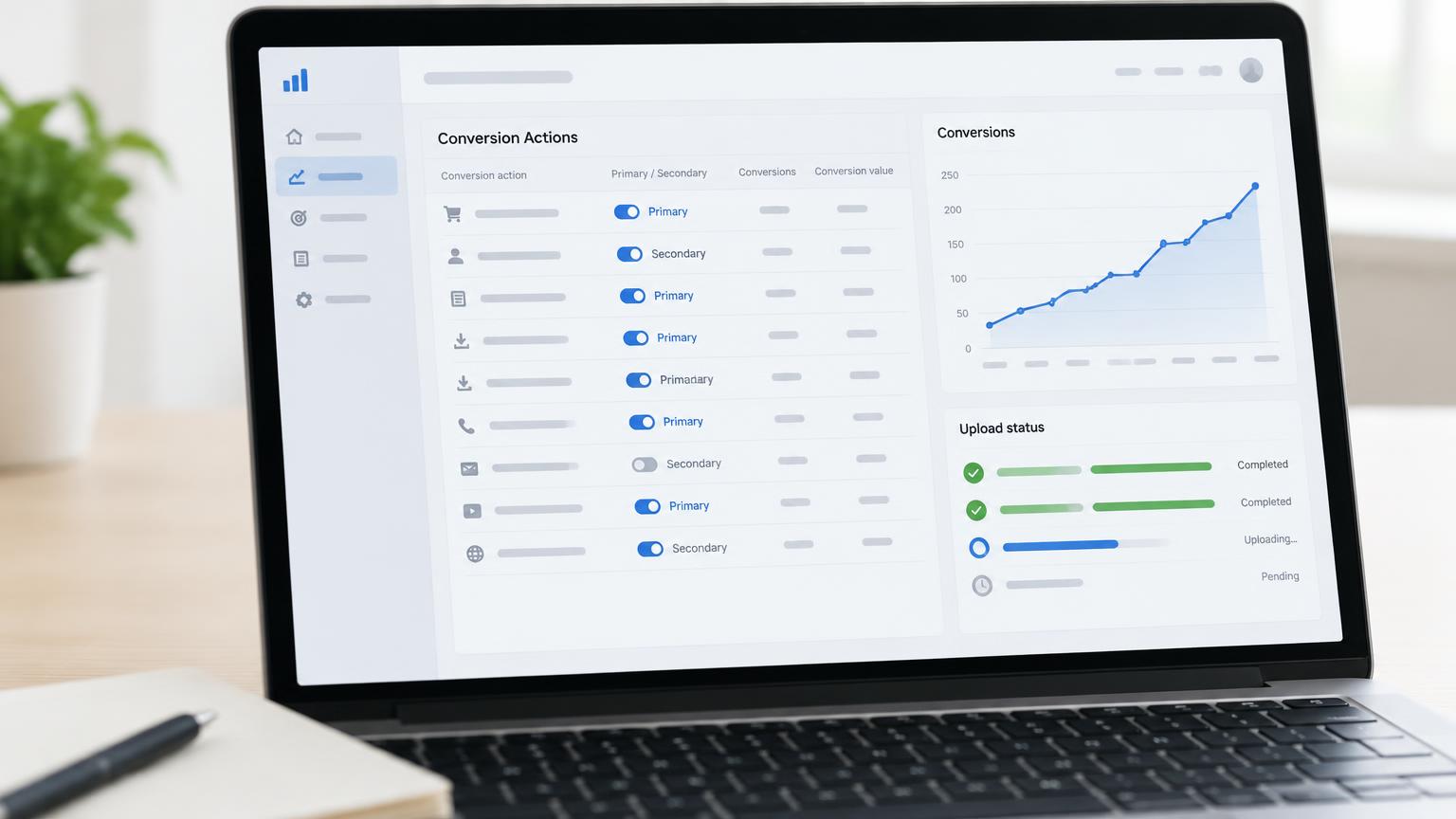
In Google Ads, open Goals, then the conversions summary, and list which actions are set to primary. If the only primary action is a form submission, changing that is the first item for your FY27 plan.
Sources
- Google: DSA upgrade to AI Max announcement
- TechWyse: AI Max migration dates
- Google Ads Help: About offline conversion imports
- Google Ads Help: Guidelines for importing offline conversions (63-day window)
- Google Ads Help: Upgrade offline conversion import to enhanced conversions for leads
- 6sense: 2026 B2B Buyer Experience Report