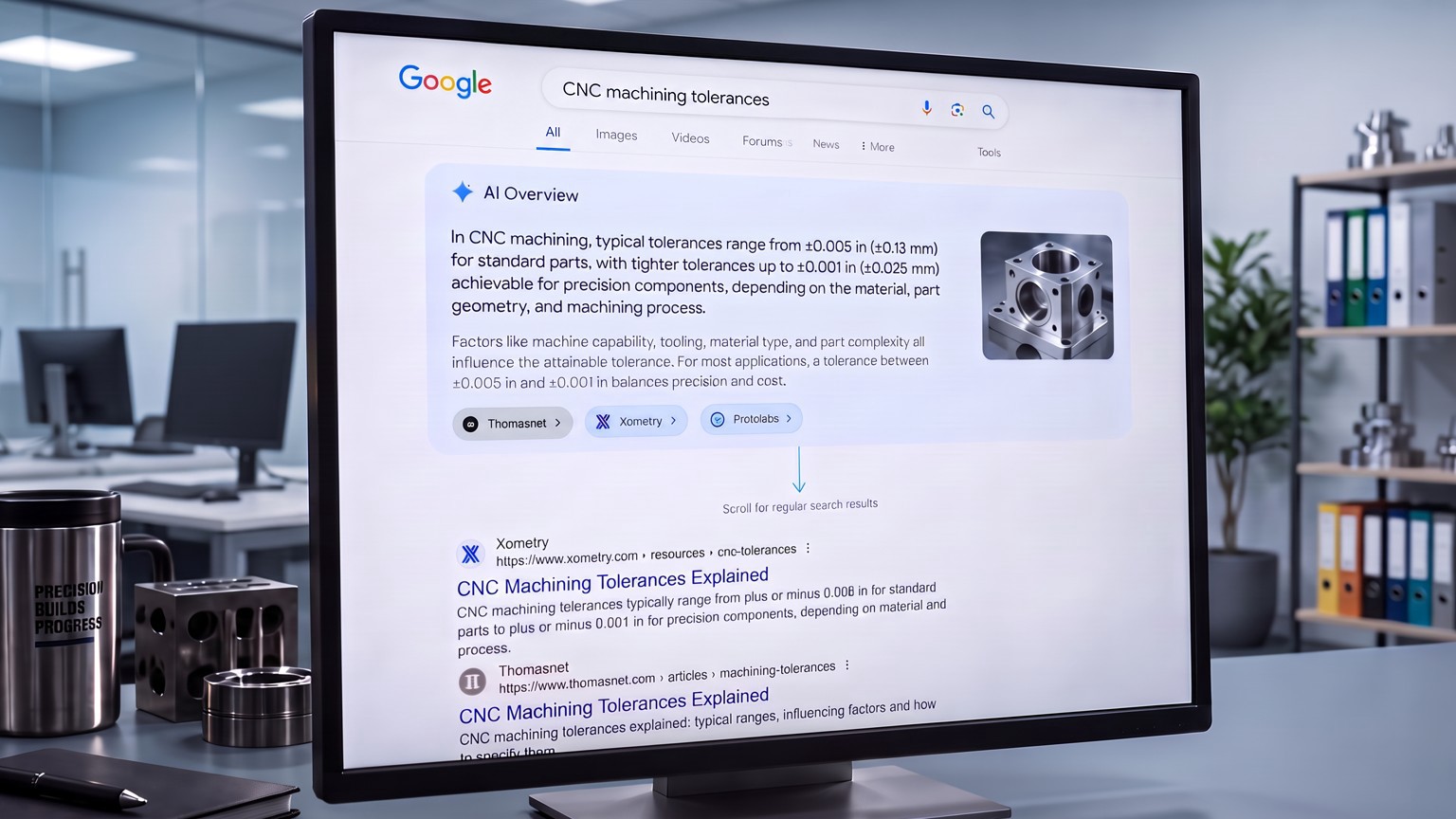
Your rankings report says your core service pages held their positions this year. Your organic inquiry count says something else. Both reports can be correct at the same time. Google's AI Overviews can reduce clicks even when a page stays visible, but they are not the only explanation.
For a marketing leader at a manufacturing, robotics, fleet or supply-chain technology company, the question is where to act first: rewrite a buying guide, protect a high-intent service query, or investigate a tracking problem. Start by separating visibility, visits and qualified inquiries.
What the 2026 research shows
Three studies measured different aspects of the change. Their percentages are not interchangeable, and none is a forecast for your own website:
- 38% fewer organic clicks in a field experiment. A randomized experiment reported by Search Engine Journal found that AI Overviews reduced organic clicks on queries where they appeared. Searches ending without a click increased from 54% to 72%. The experiment involved 1,065 U.S. desktop Chrome users; it does not represent every device, audience or query.
- 58% lower top-ranking-page click-through rate in Ahrefs' analysis. The February 2026 Ahrefs study compared 300,000 keywords using aggregated desktop Search Console data from December 2023 and December 2025. AI Overview presence correlated with a 58% lower average click-through rate for the first organic result. Its earlier study reported 34.5%; these are different comparison windows, not a precise year-over-year decline for a single website.
- An early-2026 rebound in Seer's tracked queries. Seer Interactive's April 2026 update, covering 53 brands and 5.47 million queries, reported organic click-through rate on AI Overview queries rising from about 1.3% in December 2025 to 2.4% in February 2026. That recovery did not erase the gap against queries without AI Overviews.
The useful conclusion is narrower than “SEO is over”: a first-place ranking is no longer enough to estimate visits on an AI Overview query. Measure the result page and the downstream inquiry separately.
Where industrial B2B teams should look first
Separate informational searches from commercial searches before deciding which content to change. A material comparison or “what is warehouse automation?” page serves a different job from “industrial press rebuild quote” or a fleet-platform evaluation page. These are illustrative buyer queries, not measured client results.
A buyer may get a basic definition from an Overview without visiting your guide. A technical evaluator or operations leader comparing capabilities, service coverage, compatibility or a replacement part still needs evidence specific to the purchase. Check those query groups rather than assuming they lose clicks at the same rate.
There is also a reason not to rebuild everything for chatbots this quarter. The 6sense 2026 B2B Buyer Experience Report, surveying 4,611 recent buyers, found that 81% used an LLM during an evaluation, but only 26% used one to discover vendors. Those are self-reported behaviors, not industrial-sector conversion rates.
Keep your vendor-selection evidence accessible on your website while checking what Google and AI assistants actually show. Our SEO & AI Search work treats those surfaces as connected, with separate measures for visits, citations and qualified demand.
A 30-minute monthly AI Overview check
Use this as a short triage routine for a small query list. A full audit or manual check of every term may take longer.
- Build the list. Pick 15 to 25 terms associated with real inquiries, using Search Console and your available lead history. Split them into informational terms (questions and comparisons) and commercial terms (service plus location, specifications, repair, rebuild or quote). Start with five if time is tight.
- Read Search Console. Compare clicks, impressions, click-through rate and position for each query/page pair. Use equal-length periods and a year-over-year view where useful. Keep country and device filters consistent; review changes in query mix and seasonality.
- Check the results page. Record whether an AI Overview appears and whether your page is linked as a source. Note the date, device and location. A single result-page check is a snapshot: Overviews and citations can change.
- Decide term by term. If an informational page is missing from citations, check whether it directly answers the question and supplies verifiable product or service evidence. Where accurate and relevant, make lead time, tolerance or service coverage easy to find. No layout or two-sentence formula guarantees a citation. If a commercial query loses clicks, assess the economics of a paid search test before adding spend.
- Report to Sales by page type. Compare inquiries and sales-qualified progression from service pages versus guides, where attribution permits. Report unknowns explicitly. Average position alone cannot answer whether the program is producing the right buyers.
Important limit: rising impressions and falling clicks can flag a problem, but Search Console does not isolate AI Overview traffic in these standard reports. Confirm what is appearing on the query, then rule out demand shifts, ranking changes, ads, other result features and measurement issues.
Turn the pattern into a decision
| What you see | Check next | Decision it supports |
|---|---|---|
| Stable position, lower click-through rate | Overview presence, ads and changing query mix | Prioritize the queries losing relevant visits |
| Clicks down, qualified inquiries steady | Which page types and audiences stopped clicking | Avoid rebuilding content solely to restore raw traffic |
| Service-page clicks and qualified inquiries down | Commercial intent, competitors, page fit and tracking | Investigate the sales-impacting pages first |
| Your site is cited, but clicks remain low | Whether the answer satisfies the query without a visit | Report citations separately from visits and pipeline |
The tool we use for the results-page check
We've tracked client SEO in Semrush for more than six years. Its AI Overview tracking tools can flag which tracked terms trigger an Overview and help check whether your domain appears as a source. Position Tracking also supports local targeting down to postal code, useful for regional service searches.
Keep “Overview present” separate from “our domain cited.” Neither establishes a qualified visit. For niche technical searches with low estimated volume, cross-check actual impressions in Search Console and, where available, Google Ads search-term data before dismissing a term.
Google result-page tracking and brand visibility inside ChatGPT are different tasks. Confirm the current toolkit, usage limits and seat costs before subscribing; you may need separate AI visibility tools. If your list is short and someone already reviews Search Console monthly, you can run this check manually without buying another platform.
What to do this week
Open Search Console, filter to your top five service pages, and compare October 2026 with October 2025. If clicks fell while impressions rose, put the affected query/page pairs on your investigation list. Check the current result pages before deciding that a rewrite is the answer.
Bring Sales one short summary: which commercial pages lost visits, whether qualified inquiries changed, what you checked, and the next action. That gives your team a decision it can defend instead of a ranking report that conflicts with the pipeline conversation.